How to Use Chengdu Metro: Lines, Map, Tickets & Tips for Tourists
If you’re planning a trip to Chengdu and feeling a bit unsure about using public transport—don’t worry. The Chengdu metro (also called the Chengdu subway or Chengdu underground by locals and travelers alike) is one of the most tourist-friendly systems in China. A good Chengdu travel guide will always tell you the same thing: the metro is the easiest way to explore the city. As of March 2026, the network has 18 lines, spans 758 kilometers, and serves 489 stations—making it the 4th largest metro in the country after Beijing, Shanghai, and Guangzhou. In 2025, it carried over 2.2 billion passengers, and the single-day record hit 10.03 million rides.
For visitors, the real draw is how much ground it covers. The Chengdu metro connects both airports (Shuangliu International and Tianfu International), every major train station, and nearly every tourist site you’d want to see—from the Giant Panda Base to the ancient alleys of Kuanzhai. Better yet, every sign, announcement, and ticket machine comes in both Chinese and English. You really don’t need to speak a word of Chinese to get around.
By the end of this guide, you’ll know exactly which lines to take, how to buy a ticket without fumbling, what a Chengdu metro map looks like and where to get one, and the little tricks—like free street crossings and airport express trains—that make the whole experience smoother.
- How Big Is the Chengdu Metro? A Quick Overview
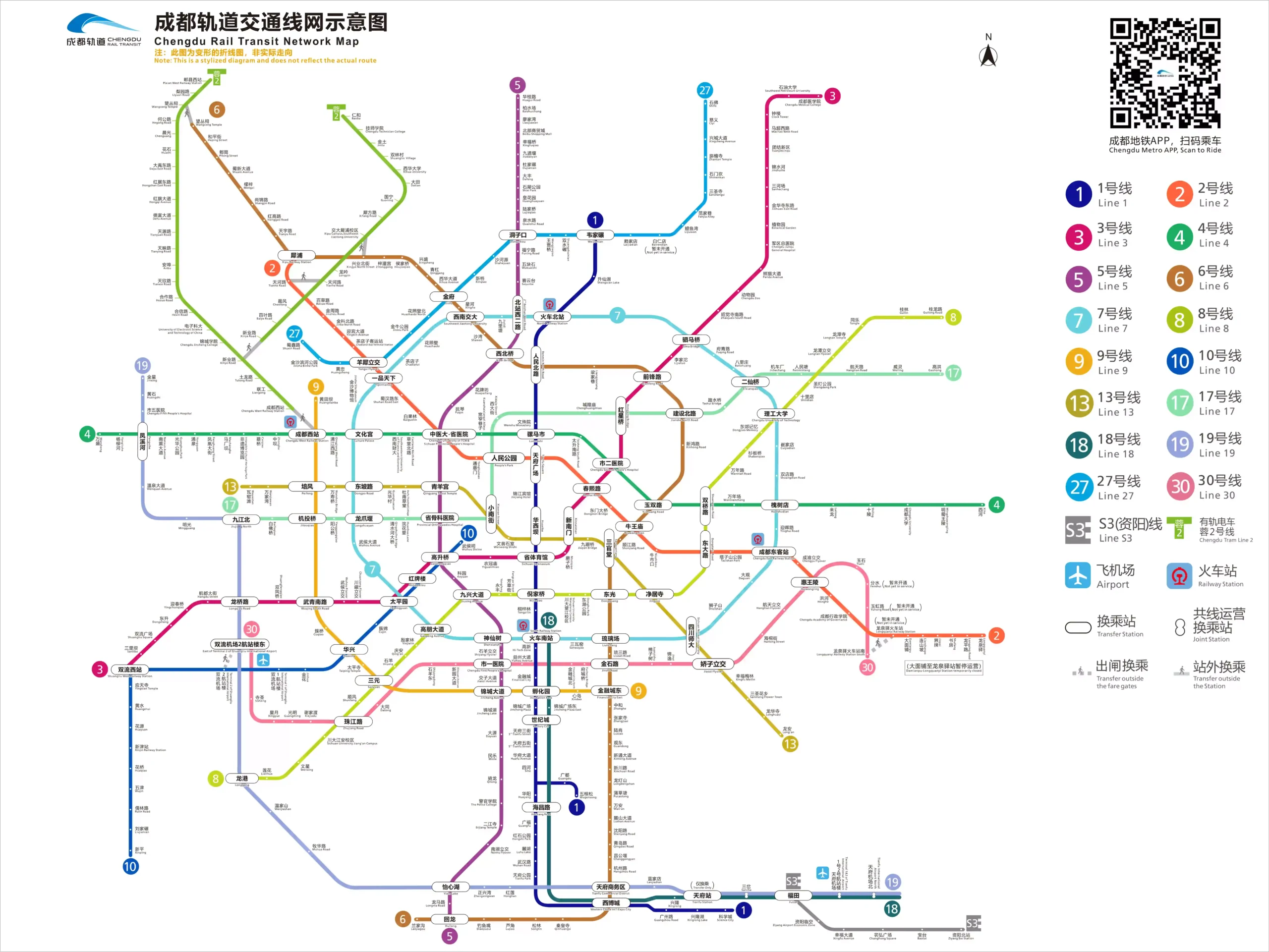
- Chengdu Metro Map: How to Get It (And Which Stations Actually Matter)
- How Much Does the Chengdu Metro Cost? (And How to Pay)
- How to Ride the Chengdu Metro: A Step-by-Step Walkthrough
- Practical Tips: Hours, Crowds, and the Little Things That Make a Difference
- Getting to Airports and Train Stations by Chengdu Metro
- What About the Tram? (A Quick Note on Line R2)
- Two Sample One-Day Itineraries (Metro-Only)
- Quick Answers (FAQ)
How Big Is the Chengdu Metro? A Quick Overview
Let’s put the numbers into perspective. The Chengdu metro covers 758 kilometers of track, placing it behind only Beijing (909 km), Shanghai (906 km), and Guangzhou (780 km) in terms of total length. It ranks 5th nationwide in annual ridership and 1st in western China. A key stat for tourists: 34% of commuters live within 800 meters of a station—which means in the city center, you’re almost always a short walk from a metro entrance.
Two new sections opened in September 2025:
- Line 17 Phase 2 extended the route east through downtown, adding useful stations like People’s Park (interchange with Line 2) and Hongxing Bridge (interchange with Line 3).
- Line 10 Phase 3 brought the airport line deeper into the city, with a stop at Wuhou Temple—so you can now go directly from Shuangliu Airport to the doorstep of one of Chengdu’s most famous attractions.
Looking ahead, Line 13 (fully automated, 21 stations) and Line 30 (linking Shuangliu Airport Terminal 2 eastward to Longquan) are both in trial operation and expected to open later this year. By 2035, the network is projected to grow to over 1,100 kilometers across 36 metro lines.
Chengdu Metro Map: How to Get It (And Which Stations Actually Matter)
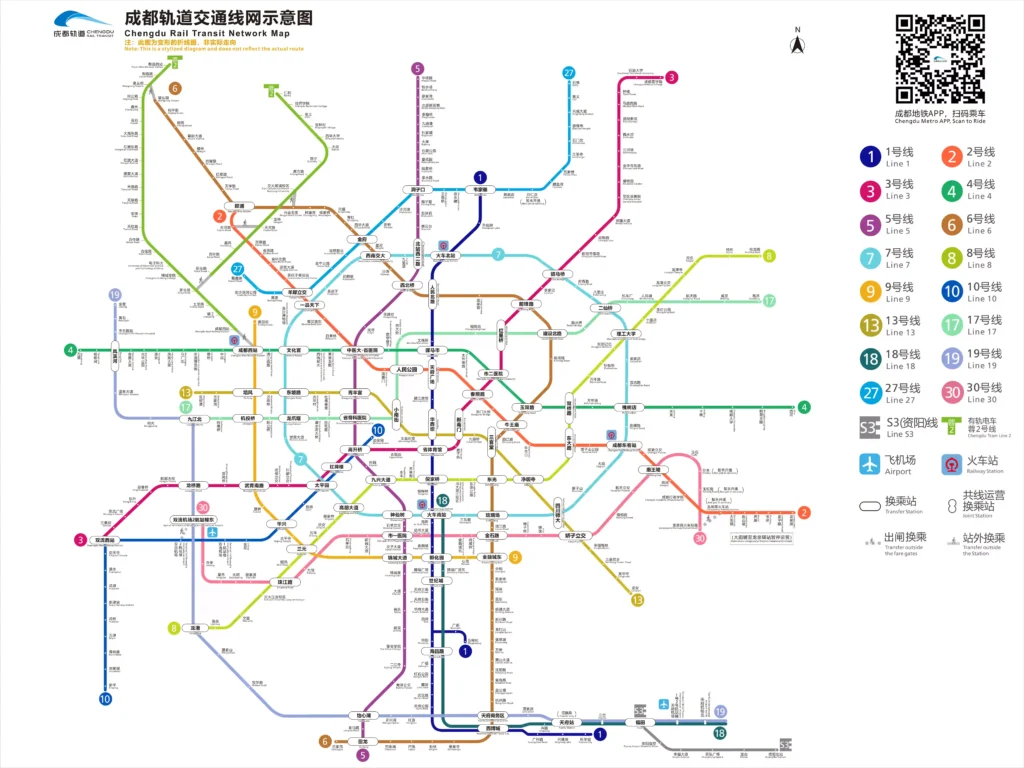
Before you even land in Chengdu, download a Chengdu metro map to your phone. Here are the best ways to get one:
- Baidu Maps or Gaode Maps (Amap). These are China’s equivalent of Google Maps and honestly work better here. Both support English search. Type in any attraction name, and the app will plan the fastest metro route, show real-time arrival times, and even tell you which exit to use. If you install just one app before your trip, make it one of these.
- The Chengdu Metro official app. It has a full Chengdu subway map, fare calculator, and live departure times. The interface leans Chinese-heavy, but the map itself is bilingual and easy to navigate.
- A PDF or image saved offline. Search “chengdu metro map PDF” or “chengdu subway metro map” before your trip and save the latest version to your phone. A number of travel blogs host clean, high-resolution versions you can zoom into.
- Physical maps at stations. Every station hall has a large bilingual route map mounted on the wall. Hotel front desks and tourist info centers sometimes carry pocket-sized copies too.
Key Metro Stations for Tourists
You don’t need to memorize all 489 stations. The table below covers the ones you’ll actually use:
| Station | Line(s) | What’s Nearby |
|---|---|---|
| Chunxi Road | L2, L3 | Chunxi Road shopping street, Taikoo Li Chengdu, IFS (the famous climbing panda sculpture), Daci Temple |
| Tianfu Square | L1, L2 | Tianfu Square Chengdu, Chengdu Museum, Sichuan Science Museum, Sichuan Art Museum |
| People’s Park | L2, L17 | People’s Park Chengdu, Heming Teahouse (classic covered-bowl tea experience) |
| Wenshu Monastery | L1 | Wenshu Monastery Chengdu, red-wall photo spots, vegetarian restaurant |
| Kuanzhai Alley | L2, L4 | Kuanzhai Alley (Qing-dynasty historic lanes) |
| Panda Avenue | L3 | Chengdu Giant Panda Breeding Research Base (take the scenic shuttle bus from the station exit) |
| Gaoshengqiao / Wuhou Temple | L3, L5 / L10 | Wuhou Shrine (50 CNY ≈ 7.15 USD), Chengdu Jinli Ancient Street |
| Caotang North Road | L4 | Du Fu’s Thatched Cottage (50 CNY ≈ 7.15 USD) |
| Jinsha Museum | L7 | Jinsha Site Museum (80 CNY ≈ 11.45 USD), home of the 3,000-year-old Sun Bird gold foil |
| Qingyang Palace | L5 | Qingyang Palace Taoist Temple (10 CNY ≈ 1.45 USD) |
| Jiuyan Bridge | L5 | Jiuyan Bridge bar street, riverside nightlife |
| Eastern Suburb Memory | L2, L8 | Eastern Suburb Memory creative park (free) |
| Financial City | L1, L9 | Twin Towers light show at night (free) |
| Chengdu East Station | L2, L7 | Chengdu East Railway Station—the city’s largest high-speed rail hub |
| South Railway Station | L1, L7, L18 | High-speed rail, metro, and the Line 18 airport express all converge here |
A quick note on tickets for attractions: Chengdu Museum, the Science Museum, and the Art Museum are free but require advance booking (closed Mondays except public holidays). Jinli Ancient Street, Kuanzhai Alley, Eastern Suburb Memory, and People’s Park are free with no booking needed. Panda Base, Wuhou Shrine, Du Fu’s Cottage, and Jinsha Museum require paid tickets—budget around 10–80 CNY (≈ 1.45–11.45 USD) each.
How Much Does the Chengdu Metro Cost? (And How to Pay)
The Chengdu metro uses a distance-based fare system. It’s cheap by any standard:
- 0–4 km: 2 CNY (≈ 0.30 USD)
- 4–8 km: 3 CNY (≈ 0.45 USD)
- 8–12 km: 4 CNY (≈ 0.60 USD)
- 12–18 km: 5 CNY (≈ 0.70 USD)
- 18–24 km: 6 CNY (≈ 0.85 USD)
- Over 110 km: add 1 CNY per 20 km
- Maximum single-ride fare across the entire network: 12 CNY (≈ 1.70 USD)
Most trips within the city center fall between 2 and 6 CNY (≈ 0.30–0.85 USD). Even the longest cross-city ride won’t cost more than a dollar or two. If you use a Tiantong Card or a metro app, you get a 10% discount automatically. On the 5th of every month (Green Travel Day), the discount bumps to 20% when using designated apps or cards. Children under 1.3 meters ride free.
Payment Methods Ranked (For Foreign Travelers)
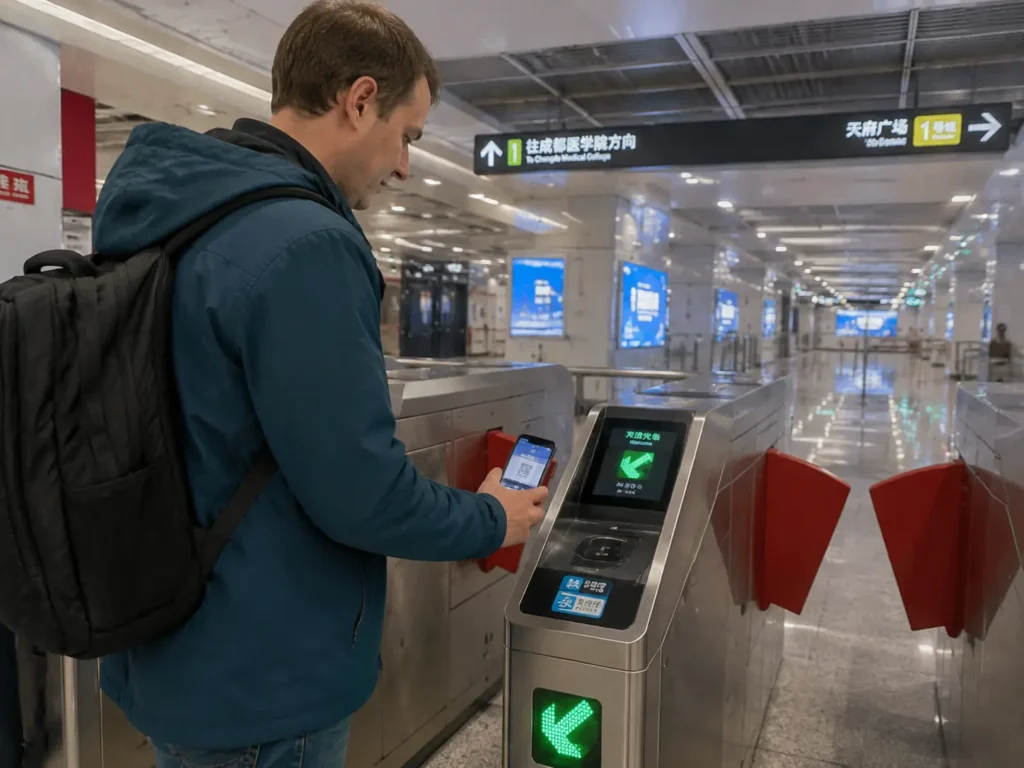
Option 1: Alipay or WeChat QR Ride Code (best for most tourists). Search “成都地铁乘车码” (Chengdu Metro Ride Code) inside Alipay or WeChat to activate the mini-program. Once it’s set up, you scan your phone at the gate and go—no cash, no ticket queue. Alipay and WeChat both support international credit cards (Visa, Mastercard, Amex). The catch: you’ll need to complete identity verification and card-linking before you arrive. Do this at home, and you’ll save yourself a headache at the station.
One crucial rule: enter and exit using the same app and the same QR code. If you scan in with Alipay and try to scan out with WeChat, the gate won’t open—and you’ll be stuck explaining the situation to a station attendant.
Option 2: Single-journey ticket from a machine (most reliable). Every station has bilingual self-service ticket machines. The process: select your line → tap your destination station → choose the number of tickets → pay by scanning WeChat/Alipay or by feeding in cash (5, 10, or 20 CNY notes, 1 CNY coins) → collect your ticket. The ticket is a small paper card with a QR code printed on it. Keep it—you’ll need to insert it into the gate slot when you exit. Most machines do not accept international credit cards directly, so have some cash or a working mobile payment app ready.
Option 3: Tiantong Card (good for stays of 3+ days). This is Chengdu’s stored-value transport card. Buy one at any metro station service counter for a 20 CNY (≈ 2.85 USD) deposit. It works on both the metro (10% off) and city buses (50% off). Top up at self-service machines using cash or mobile payment. Worth it if you plan to ride frequently over several days. For a short 1- or 2-day visit, stick with QR codes or single tickets.
Option 4: Face-scan entry. Some stations support facial recognition entry via the Chengdu Metro app. For short-term visitors, the setup process is a bit involved—probably not worth the effort unless you’re staying long-term.
Option 5: UnionPay QuickPass / CloudFlashPay App. Works at selected gates if your card supports it. Coverage is inconsistent, so don’t rely on this as your primary method.
A note about Apple Pay and Google Pay: the metro gates generally don’t accept them directly (unless linked to a UnionPay card via QuickPass). Your safest bet is Alipay, WeChat, or a physical ticket.
How to Ride the Chengdu Metro: A Step-by-Step Walkthrough
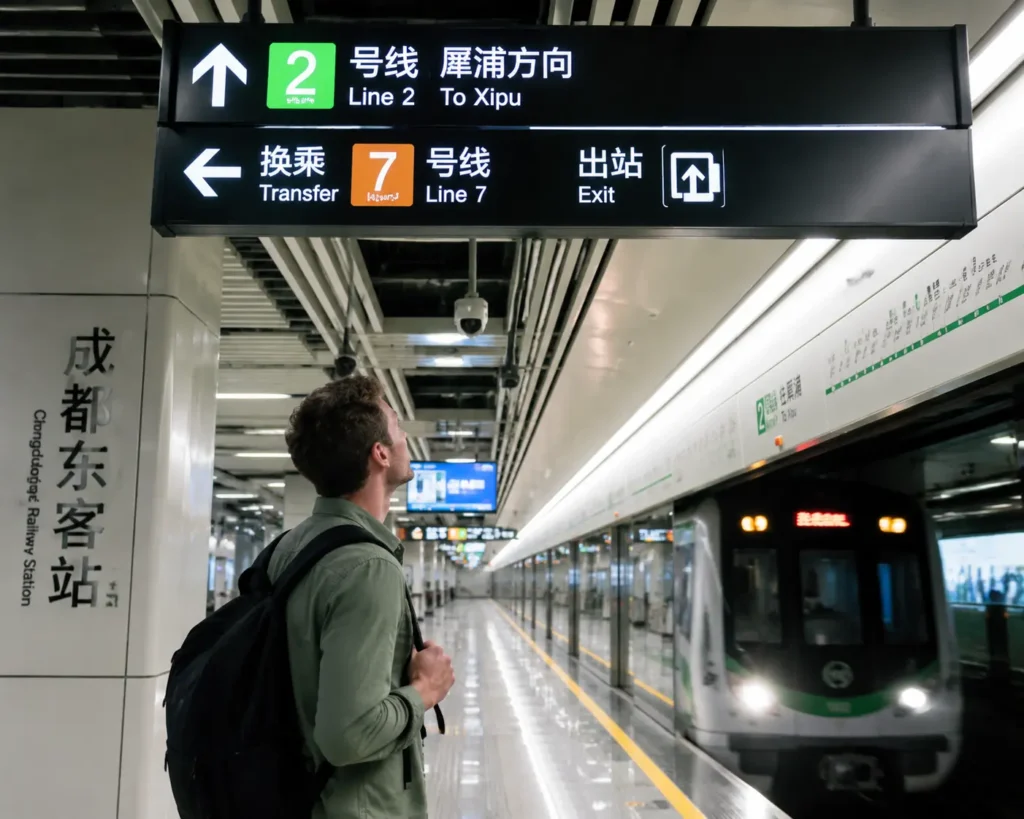
If you’ve never used a Chinese metro before, the whole process might feel intimidating. It’s actually very straightforward. Here’s each step, from street level to your destination:
Step 1: Get your ticket or open your ride code. Before you even approach the gate, have your QR code ready on your phone or your single-journey ticket in hand. Digging through your bag at the turnstile during rush hour is not a good time.
Step 2: Go through security. Everyone and every bag goes through an X-ray scanner. If you’re carrying a water bottle or any liquid, security may ask you to take it out for a quick check. This is also where the spray-and-liquid limits kick in: you’re allowed up to 2 bottles of spray/aerosol items (sunscreen, hairspray, perfume, etc.), each no more than 500ml. Alcohol-based products like hand sanitizer and mosquito repellent follow the same rule. Baijiu (Chinese liquor) under 56% ABV is capped at 4 bottles or 2 unopened cases. If you’re carrying a balloon, deflate it first.
Pets aren’t allowed (service dogs excepted), but small ornamental fish or turtles in sealed, leak-proof containers are fine. Security lines move fast—usually less than a minute, slightly longer during rush hour.
Step 3: Tap or scan through the gate. QR code users: hold your phone screen over the scanner until the gate opens. Ticket users: tap the paper card on the reader. One person per tap—don’t tailgate.
Step 4: Find the right platform. Look up at the overhead signs above the platform doors. They show the line name, direction, and terminal station. Heads up on Line 1: at Sihe Station, the line splits into two branches—one ending at “Science City,” the other at “Wugensong.” Check the display on the arriving train to make sure it’s heading where you want to go. If you board the wrong branch, just get off at Sihe and switch.
Step 5: Wait behind the yellow line. Queue lines are marked on the platform floor. Let passengers exit first, then board. It sounds obvious, but in a crowded station, this small courtesy makes everyone’s life easier.
Step 6: On the train. Every carriage has a dynamic route map above the doors showing the current station and next stop, with bilingual voice announcements. Keep an eye on it—stations come up faster than you might expect.
Step 7: Exit the station. QR code users scan out the same way they scanned in. Ticket holders insert the paper ticket into the gate slot (it gets swallowed and recycled). Then follow the overhead exit signs. Most stations have exits labeled A through D (or more). Baidu Maps or Gaode Maps will tell you which exit to use for your destination—this is genuinely useful, since picking the wrong exit can leave you on the opposite side of a 6-lane road with no easy crossing.
Practical Tips: Hours, Crowds, and the Little Things That Make a Difference
Getting around a Chinese city can feel daunting at first, but once you understand a few basics, how to get around Chengdu by metro becomes second nature. The system is logical, well-signed, and forgiving of mistakes. Here’s what you need to know to ride like a local.
Operating hours. Most lines run from roughly 6:10 AM to 11:00 PM. Exact times vary slightly by line and direction—check Baidu Maps, Gaode Maps, or the Chengdu Metro app for real-time schedules. During major public holidays, service often extends to around 1:00 AM. Lines 18 and 19 run express trains (fewer stops, faster) with separate timetables—worth checking if you’re heading to Tianfu Airport.
Rush hour. The morning crush runs 7:30 AM to 9:00 AM (peak intensity around 7:45–8:45 AM). Evening rush is 5:00 PM to 7:00 PM. The worst-hit stations are Tianfu Square, South Railway Station, Incubation Park, Tianfu 3rd Street, and Tianfu 5th Street—all along Line 1, which is by far the busiest line in the system. If you’re sightseeing, aim to travel between 9:30 AM and 4:30 PM for a far more comfortable ride.
Free street crossing at select stations. Here’s a trick most tourists don’t know about. At 23 designated stations, you can enter through one exit and leave through another within 15 minutes without being charged. This is perfect for crossing busy roads underground or if you realize you left something behind right after entering. Stations where this works include Financial City, Hi-Tech Zone, South Railway Station, People’s Park, Gaoshengqiao, Hongxing Bridge, Xipu, and Chengdu University of Technology—among others.
Changed your mind? If you enter the station and decide not to ride within 10 minutes, head to the service counter before passing through the exit gate. Staff can process a free exit for you.
Lost something? Tell any station staff member immediately. Give them your route, the time you were on the train, and a description of the item. You can also check the “Lost & Found” section in the Chengdu Metro app or call the service hotline at 028-61638000.
Door safety. When the doors are about to close, you’ll hear a rapid “beep-beep-beep” and see red lights flashing. Do not rush the doors at this point—it’s the number one way tourists get separated from their travel companions. If a bag strap or jacket gets caught, the doors will automatically reopen. Pull your item free quickly.
Onboard etiquette. Eating and drinking are not allowed inside the carriages. Don’t play audio out loud from your phone (there are signs reminding passengers of this). Priority seats near the doors are for the elderly, pregnant, disabled, and those with young children. Quiet, tidy, and considerate—that’s the norm.
Getting to Airports and Train Stations by Chengdu Metro
The Chengdu metro is the cheapest and often fastest way to reach the city’s transport hubs:
- Shuangliu International Airport (CTU): Line 10 serves both Terminal 1 and Terminal 2. From the city center (transfer at Taipingyuan on Line 3/7), the ride takes about 20–30 minutes.
- Tianfu International Airport (TFU): Line 18 runs express and regular services from South Railway Station. The express train takes roughly 50 minutes from downtown—faster than a taxi during traffic. Line 19 also connects the two airports directly, useful if you have a transfer between CTU and TFU.
- Chengdu East Railway Station: Served by Line 2 and Line 7. This is the city’s largest high-speed rail hub, with trains to Chongqing, Xi’an, Guilin, and beyond.
- Chengdu South Railway Station: Served by Line 1, Line 7, and Line 18—a major interchange where the metro, high-speed rail, and airport express meet.
- Chengdu West Railway Station: Served by Line 4 and Line 9.
- Chengdu Railway Station (North Station): Served by Line 7. Note that this station is undergoing long-term renovation; check current service status before relying on it.
For detailed walking routes inside the airports, luggage tips, and transport comparisons, see our full Chengdu Airport Guide. If you’re arriving by high-speed rail and need to know which station to book, we have a separate Chengdu Train Stations Guide to help you choose.
What About the Tram? (A Quick Note on Line R2)
Chengdu also has a tram line—the R2 (Rong 2 Line)—running through the western suburbs. It uses a flat fare of 2 CNY (≈ 0.30 USD) per ride. Board first, then buy your ticket onboard. If you get off and re-board, you’ll need a new ticket. When crossing streets near tram tracks, use pedestrian crossings and watch for traffic lights. For most tourists, the tram won’t be a primary way to get around—the metro covers almost everything you’ll want to see. But it’s good to know it exists if your itinerary takes you west of the city center.
Two Sample One-Day Itineraries (Metro-Only)
If you’re looking for more things to do in Chengdu, these two routes make excellent starting points—and the metro ties them together seamlessly.
Route A: Old Chengdu & City Icons. Start your morning at People’s Park (Line 2)—order a cup of jasmine tea at Heming Teahouse, one of the most authentic Chengdu tea houses in the city, and watch locals play mahjong. From there, ride one stop to Kuanzhai Alley (Line 2/4) and wander the Qing-dynasty lanes. Midday, hop on Line 1 to Wenshu Monastery for red-wall photos and a vegetarian lunch at the temple restaurant.
End the afternoon at Chunxi Road / Taikoo Li (Line 2)—spot the giant climbing panda at IFS, then explore Daci Temple tucked between luxury storefronts. This entire route moves through the city at a relaxed pace, with no more than 10 minutes between stops.
Route B: Pandas & Ancient Shu Culture. Be at Panda Avenue Station (Line 3) by 8:00 AM—pandas are most active in the morning, and the base gets crowded by 10. Take the scenic shuttle from the metro exit to the panda base entrance. After lunch, head to Wuhou Shrine and Jinli Ancient Street (Line 3/10, Gaoshengqiao or Wuhou Temple station). The shrine’s red-walled bamboo corridor is one of the most photogenic spots in the city. Jinli lights up beautifully after dusk.
If you still have energy, finish at Jinsha Site Museum (Line 7)—the Sun Bird gold artifact and 3,000-year-old ivory relics are worth the 80 CNY (≈ 11.45 USD) admission. This route is tighter on time, so aim for an early start.
Quick Answers (FAQ)
What’s the difference between Chengdu Metro, Chengdu Subway, and Chengdu Underground?
Nothing. They all refer to the same system. “Metro” is the official English name used on signs. “Subway” is the common American term. “Underground” is more British. Locals and travelers use all three interchangeably—and search results for chengdu metro and chengdu subway bring up the exact same system.
Can I bring luggage on the metro?
Yes, no extra charge. But try to avoid rush hour with a large suitcase—you and your bag will both suffer.
Is there Wi-Fi?
Patchy free Wi-Fi (“Chengdu Metro WiFi”) exists in some stations and carriages, but it’s unreliable. Bring your own data plan or an eSIM.
Do the ticket machines take international credit cards?
Most don’t. Use cash (RMB) or mobile payment (Alipay/WeChat) at the machines instead.
Can I use Apple Pay or Google Pay?
Not directly at the gates. If your card is linked to UnionPay and supports QuickPass, it might work at some gates—but this is hit-or-miss. Stick with Alipay, WeChat, or a paper ticket.
Why can’t I mix apps when entering and exiting?
The system tracks your journey by matching the QR code you used at entry. Scan in with Alipay, scan out with WeChat, and the gate has no idea where you boarded—so it won’t open. Always use one app for the full ride.
Is the metro accessible for wheelchairs and strollers?
Most stations have elevators and accessible gates. Look for the wheelchair symbol on station signage.
How late does it run?
Around 6:10 AM to 11:00 PM for most lines. Extended hours during public holidays. Check a live map app for exact times on your travel date.
Are there day passes or tourist tickets?
As of early 2026, the Chengdu metro does not offer a 1-day or 3-day unlimited pass (unlike Shanghai or Beijing). If that changes, the official Chengdu Metro app will be the first place to check.
How do I say the station name if I need help?
Point to it on a map or show it written on your phone. Station staff are used to helping non-Chinese speakers this way. You don’t need to pronounce anything.
The Chengdu metro is one of those rare systems where everything just works—clean trains, clear signs, and a network that puts the entire city within reach for pocket change. Grab a map, pick a line, and go see what this city does best, one stop at a time.
This guide can become your real trip
Instead of spending hours piecing everything together, let me and our team build the perfect Chengdu itinerary for you — complete with panda visits, hot pot dinners, and the best local tea houses.
📋 Plan My Chengdu Trip